
 T.A. Stafford
Where a Gale is Just the Opening Argument
Consider what that means: a gale is no breeze. It’s a sustained, powerful force that is enough to churn the sea into a raging, white-capped frenzy. For most mariners, it commands respect and caution. For the captain of BC Ferries’ Northern Expedition on its northernmost route, it is the common background noise of the season; the baseline from which all other, more violent weather intensifies.
To understand his calm, picture the stage. The bridge on a winter night in Hecate Strait. Beyond the windows, a darkness so complete it feels solid. The wind roars constantly against the steel. The 152-metre ship moves through famously shallow, treacherous water. Here, waves don’t roll, they rear up, steep and close. Radar screens cast a green glow on the focused watch keepers. At least three are always on the bridge, a vigilant team in the heart of the storm.
“Around here, in the winter, a gale warning is just… a normal day.”
Captain Dylan Fowler
This is not an emergency. This is the job. This is his command.
The same waters that in summer gift passengers with the serene majesty of the Inside Passage; sunlit fjords, glassy channels and breaching whales; transform in winter into one of Canada’s most formidable marine corridors. The summer voyage is an 18-hour scenic cruise. The winter run stretches to a 22-hour marathon, daylight is scarce, and the weather over the shallow strait can turn from challenging to dangerous with little warning.
His statement is not a boast. It is a simple fact of professional life. The real tests come when the forecasts escalate to storm force or, occasionally, hurricane force winds. It is then that Captain Fowler’s steady presence, his quiet competence forged over years on the water, becomes the critical anchor point for safety, schedule, and the peace of mind of everyone on board.
Several years into his role as Captain, Fowler, embodies this grounded composure. He speaks with the precision of a navigator and the quiet confidence of someone who has earned his place here. His journey to the bridge of the Northern Expedition is a blend of legacy, rigorous training, and a deep-seated affinity for a coast that demands respect in all its seasons.
Growing up in Sidney, the water and boats were simply the backdrop of life. A much admired father, a BC Ferries captain himself, was also part of the story. “I always admired his responsibility, his relationship with his crew,” Fowler says. The path, however, was his own to choose. He enrolled in BCIT’s Nautical Sciences Cadet Program, a gruelling four-year co-op that slingshots students into the industry through alternating semesters of classroom theory and sea time as an apprentice, or “cadet.”
His professional sea legs were built on the global stage, serving on international oil tankers. “Got to see many different ports around the world. It was a great experience.” But the call of home waters and a sought-after opportunity brought him to BC Ferries in 2017, starting as a casual third officer in Prince Rupert. The North, with its unique rhythms and demands, has been his entire BC Ferries career, ascending through the ranks to captain in October of last year.
The Unique Pulse of the Northern Run
The Northern Expedition operates on a rhythm distinct from the rest of the fleet. The crew works a demanding schedule of two weeks on, two weeks off, living aboard during their shift. It is a 24/7 operation. The ship sails through the night and day, a moving micro community threading its way through the Inside Passage to Port Hardy or across the open expanse of Hecate Strait to Haida Gwaii.
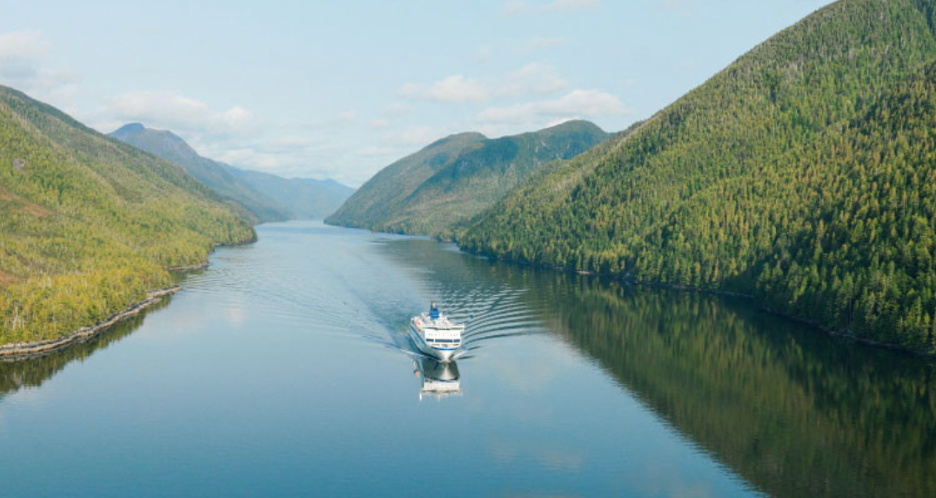
“A typical day for me changes all the time,” Fowler explains. His overarching mandate is the safe navigation and operation of the ship. That means overseeing a team, managing the endless variables of schedule and weather, and ultimately taking command for arrivals and departures. The bridge is never a lonely place. A minimum of two officers and one deckhand are always on watch, swelling to five or more during critical manoeuvres. The training is vigorous and constant, a necessity for the waters they traverse.
The statistics hint at the scale. It is a 277 nautical mile journey between Port Hardy and Prince Rupert through the Inside Passage, and a 95 nautical mile open water crossing of Hecate Strait to Haida Gwaii. In winter, the northern voyage can stretch to 22 hours. It is a route famed for its raw beauty, for snow dusted mountains plunging into deep, dark water and forests that crowd the shoreline. But it is also famed for its capacity for ferocity.
The Crucible: Hecate Strait
When Captain Fowler speaks of the most demanding part of the route, his focus narrows to a specific stretch of water. Hecate Strait. The 95 nautical mile crossing to Haida Gwaii is, in his professional assessment, “quite dynamic.” It is a masterful understatement for a body of water with a formidable reputation.
“The community relies on our vessel and understands that, these times of year, the weather is what rules the sea.”
Captain Dylan Fowler
To the casual observer on a chart, it is merely an open expanse between the mainland and the islands. The strait is wide and, crucially, shallow. Its depths range from just 25 to 60 metres, unlike the fathomless, fjord-like depths of the Inside Passage.
This shallow basin also acts as a massive funnel. It catches and amplifies the weather systems that barrel down from the Gulf of Alaska or spin off the Queen Charlotte Low. The winds, he explains, “can change so dramatically here.” The winter, from late September through March, is the Strait’s dominant season. “It is a tough time,” Fowler says. His dark humour about gale force winds being “good weather” finds its origin here. When the forecasts escalate to storm force, or the rare but sobering hurricane force warnings, “That is where we really have to be on the ball and be careful.”
His role transforms in these moments. He is no longer just a navigator but a tactician, constantly “keeping an eye on the weather.” The schedule, a lifeline for the remote communities he serves, becomes a flexible instrument of safety. Sailings are delayed, sometimes by ten or twelve hours, to “avoid the worst of it.” He speaks of the understanding that has developed with the communities of Bella Bella, Klemtu, and Haida Gwaii. “The community relies on our vessel and understands that, these times of year, the weather is what rules the sea.” This is the unspoken contract of the north. The ferry is a lifeline, but the Strait holds the pen. Captain Fowler’s expertise lies in reading its intentions and negotiating a safe passage.
There is no dramatized tale of a single, harrowing crossing in his account. That is precisely the point. His steadiness is defined by procedure, vigilance, and the deep-seated knowledge that in Hecate Strait, respect is not optional. It is the relentless, ever-present variable in the complex equation of his command. It is a brooding character in the story of every winter voyage, demanding a captain’s full and unwavering attention.
Lifeline: More Than a Ferry
For visitors, the Northern Expedition is a ferry. For the remote communities of the central and north coast, It’s their connection to the world.
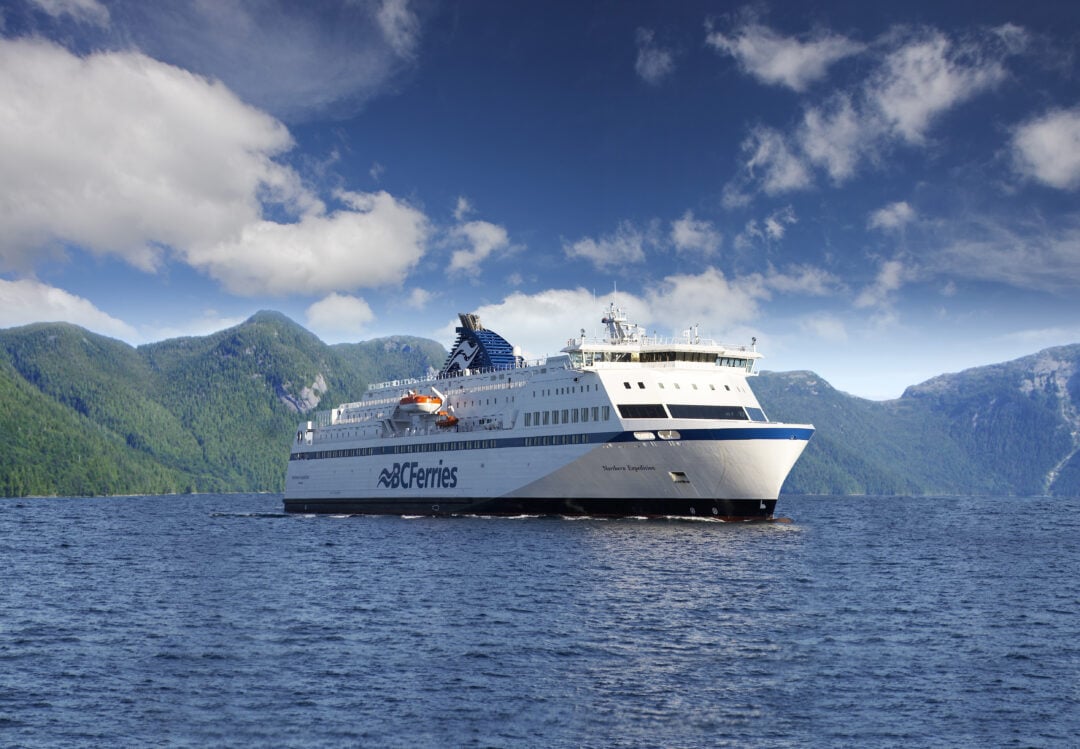
“We are definitely a bit of a lifeline,” says Captain Fowler, citing Bella Bella (Heiltsuk Nation), Klemtu (Kitasoo Xai’xais Nation), and Haida Gwaii. Many are accessible only by boat or plane. Here, the ferry’s horn is the sound of connection.
The cargo defines the mission. “We bring in a lot of provisions, stores, building supplies.” This means the semi-trailer of groceries for the Haida Gwaii Co-op, the shipment of drywall for a community hall, and the delivery of mail carrying medicine and parcels.To move it all, the route offers a unique service: hostling. “Basically, you do not need to be with your vehicle to travel.” Crew drivers load everything from cars and fishing boats to the massive “drop trailers” of commercial semis.
The human cargo reveals deeper rhythms. Fowler sees families bound for medical trips or potlaches, sports teams, and entire communities mobilizing.
This dependency creates a unique bond. With fewer passengers than southern routes, faces become familiar. “We get to know the people of the communities we serve,” he says. The crew’s ethos is to solve problems, whether fixing a vehicle on deck or rerouting a critical part. They know the stakes are high. “We are not just back in the dock in two more hours.” A delay here is a serious disruption.
“You rely on each other, you have each other’s backs,” Fowler says. “Not only professionally, but for each other’s safety, too.”
Captain Dylan Fowler
Captain Fowler’s bridge commands more than a ship. It is the nerve centre for vital coastal infrastructure. Every decision about weather or schedule ripples outward, affecting supplies, timelines, and the very cohesion of the communities he serves. It affects the price of bread in Masset, the timeline of a construction project in Bella Bella, and the ability of a family to gather for celebration or solace. A steady hand on the helm ensures the lifeline holds.
The Ship’s Heart: Crew & Command
Captain Fowler’s professional world extends beyond the navigation charts and weather systems to the more complex human geography of the ship itself. The Northern Expedition is not just a workplace. For two week stretches, it is a home, a closed community, and a society at sea. “It is pretty special being part of a crew,” he reflects. This sentiment is the bedrock of operations on the Northern Route.
The rhythm of “two weeks on, two weeks off” creates a unique intensity. “You rely on each other, you have each other’s backs,” Fowler says. “Not only professionally, but for each other’s safety, too.” The crew he works with are more than colleagues. They are the people who share the midnight watch during a gale. They understand the peculiar fatigue of a 22-hour winter voyage. They share the quiet wonder of a Spirit Bear sighting off Butedale.

His own journey through this micro society, from the casual third officer he was in 2017 to the Captain he is today, has shaped his view of command. He speaks of his father, with deep respect. It is not for his rank, but for “his relationship with his crew, how much he respected them and how much they respected him back.” This is the model Fowler carries onto the bridge. His authority is not a brittle thing. It is built on the trust earned through shared experience and the mutual respect essential in such an isolated, high stakes environment.
A Mariner Ashore: Life in Prince Rupert
When the two week shift ends and Captain Fowler steps off the gangway in Prince Rupert, he transitions from commanding a maritime lifeline to being part of a coastal community that understands the sea’s dual nature. He moved here in 2017 for the job, and found more than just a point of assembly. “It has been a very welcoming community,” he says. His life ashore is still intimately tied to the coast. His partner, Karina, is a whale researcher. She is, as he says, “on the water just as much as me.”
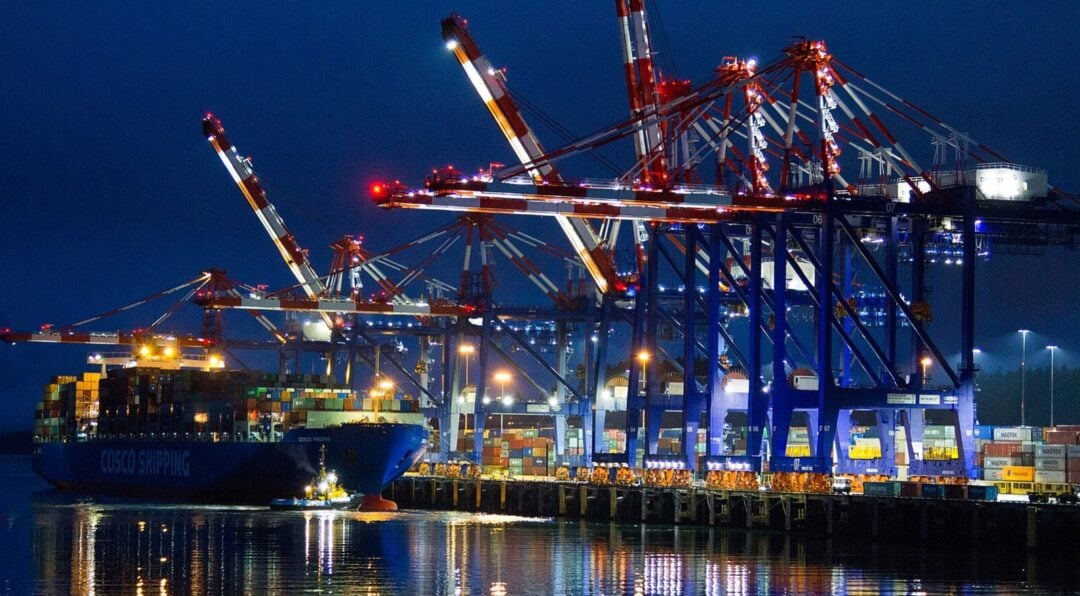
His description of northern life hinges on a re-calibrated sense of scale. “Distance and isolation mean something different when you live in the north.” The flip side of this isolation, he notes, is opportunity. The port city is booming with expansion. There are new container cranes and liquid petroleum gas terminals on Ridley Island. This creates “lots of industrial work” and “good paying jobs.” Crucially, it offers a reality increasingly elusive further south. “You do not need to have a million dollar mortgage to own a house with an ocean view.”
The Constant in the Contrast
Captain Dylan Fowler’s story is ultimately one of steadfastness amidst profound contrast. His “normal day” spans the spectrum of the North Coast’s character, from its most benevolent to its most fierce. He is a constant figure in a landscape of variables.
“I love being on the ocean. It is one of the most beautiful routes in the world. You never know what you can see.”
Captain Dylan Fowler
The contrast defines the job. It is the difference between the summer passage, an 18 hour daylight cruise where the Inside Passage lives up to its global reputation for serene, breathtaking beauty, and the winter marathon. It is the chasm between a calm, glassy Hecate Strait under a rare, cold blue sky and the same strait hours later, boiling under hurricane force winds. His professional skill must be as adaptable as the weather, yet his demeanor remains anchored.
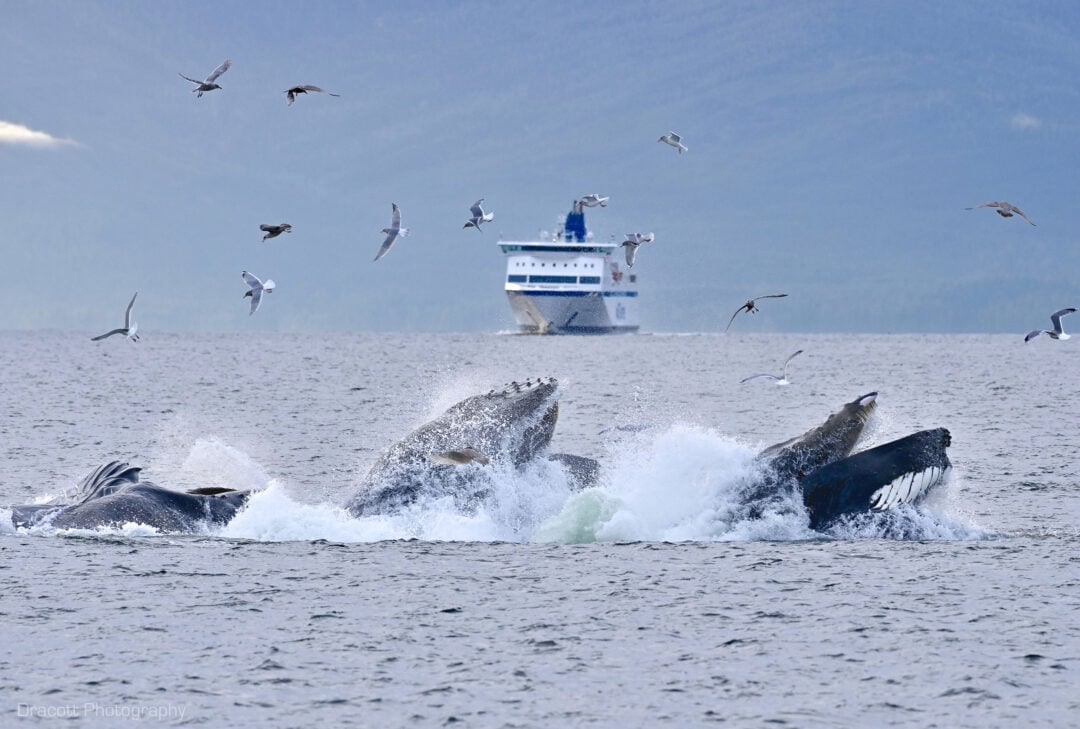
When asked what still takes his breath away after all these trips, his answer returns not to the storms, but to the privilege of the passage. “I love being on the ocean. It is one of the most beautiful routes in the world. You never know what you can see.” He speaks of the “fantastic things,” the Spirit Bear on the beach near Butedale, the pods of orcas, the humpbacks, with the appreciation of someone who has not let familiarity breed indifference. “I will not ever stop admiring it, for sure.”
This is the full circle of his command. The same unwavering focus that safely shepherds the Northern Expedition through a winter gale also allows him, and everyone aboard, to fully receive the coast’s majestic generosity in the calm. His is not a story of conquering the sea. It is a story of a deep and respectful dialogue with it. He listens to its forecasts, respects its power, negotiates its tempers, and, in return, is granted passage through one of the planet’s most stunning seascapes.
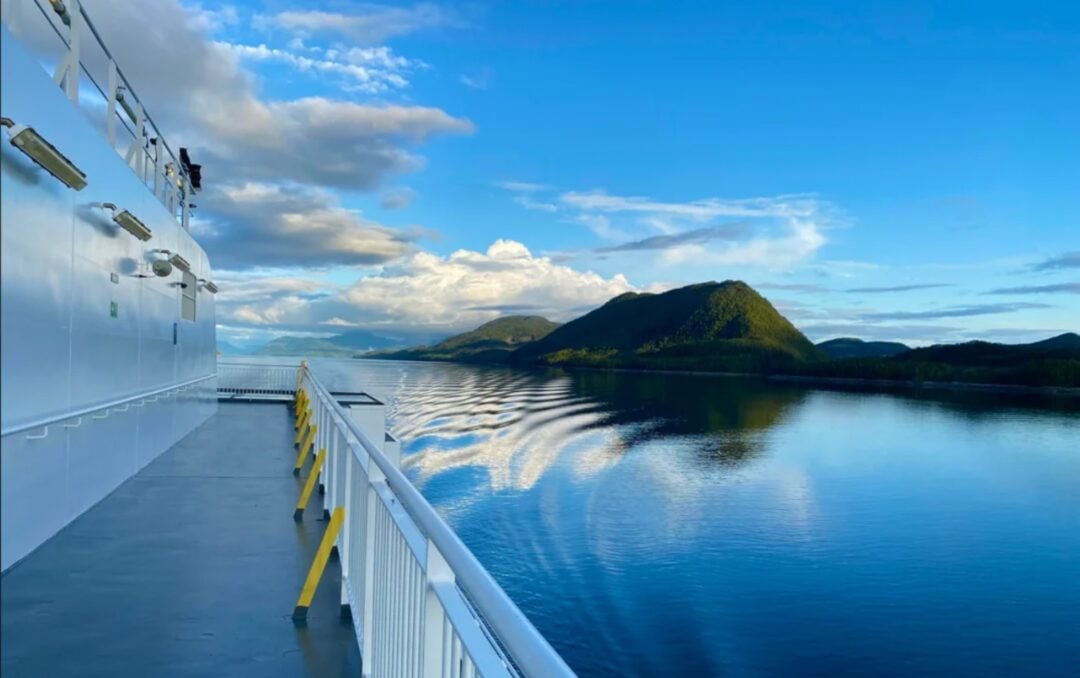
Captain Fowler’s steady hand on the helm is what makes the mighty, mercurial North Coast not just a challenge to be survived, but a home to be served, a workplace to be mastered, and a wonder to be continually admired.



Great piece!
My husband was a Snr. Chief Engineer on the “Queen of the North”, BC Ferries. It was his favourite ship of all the ships he sailed in his lifetime, which were quite a few and just before his retirement he invited me for a trip and I got to see first hand what he meant. It was a superb cruise, the scenery was breath taking and on one occasion I was invited to the bridge and met the Capt and crew. They were wonderful and on route the Capt. pointed out some Komodi bears These were not brown in colour but had whitish beige coat and there was a group of them foraging on the beach and it was a magical moment for me. It was apparently not a sight regularly seen. I felt so thrilled. Peter was devastated when the news of the Queen ship of the fleet sank and never really got over it. It was his love, pride and joy. I can understand Capt Dylans love for his ship and route.